|
The article is based on findings from doctoral work done by Elin Larsson and Christoph Langhammer. Co-authors are Igor Zoric and Bengt Kasemo, all in chemical physics at Chalmers. The discoveries pave the way both for new measurement techniques in the nano field and the development of entirely new, hypersensitive sensors. With the new technology it will be possible to study catalysts in real time under realistic conditions, thus enhancing our knowledge of catalytic processes and helping develop new catalysts. This helps bring down the use of both materials and energy in a number of processes and moreover reduces environmentally toxic emissions both from industry and vehicles.
|
 |
|
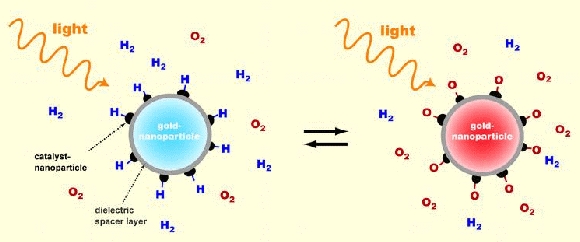
The plasmon resonance in a gold
nanoparticle is exited with light so that the particle appears
to have a color. If there is a change in e.g. the molecules
adsorbed onto the catalyst nanoparticles, this will be sensed by
the gold nanoparticles, inducing a change in their color. |
Sensors are used daily in numerous areas, everything from medical diagnostics and control of industrial processes to combustion and catalytic cleaning of exhausts from vehicle engines. Today's sensors are often expensive and/or insufficient owing to short lifetimes, low selectivity and sensitivity, and lack of durability in demanding environments. The new method is extremely robust and technologically simple, which will enable the development of inexpensive and robust sensors. The research is continuing, targeting a number of diverse applications. Elin Larsson is further developing the method for the catalytic field at the Competence Center for Catalysis, KCK, at Chalmers. Commercialization is being planned in the CleanSense Project, which was started within the framework of the Chalmers School of Entrepreneurship. The research has largely been pursued as part of the SSF-funded project Photoactive Nanostructures, and is now continuing in the Nanotechnology for Sustainable Energy Project, funded by the Chalmers Foundation and the Swedish Energy Agency.
|